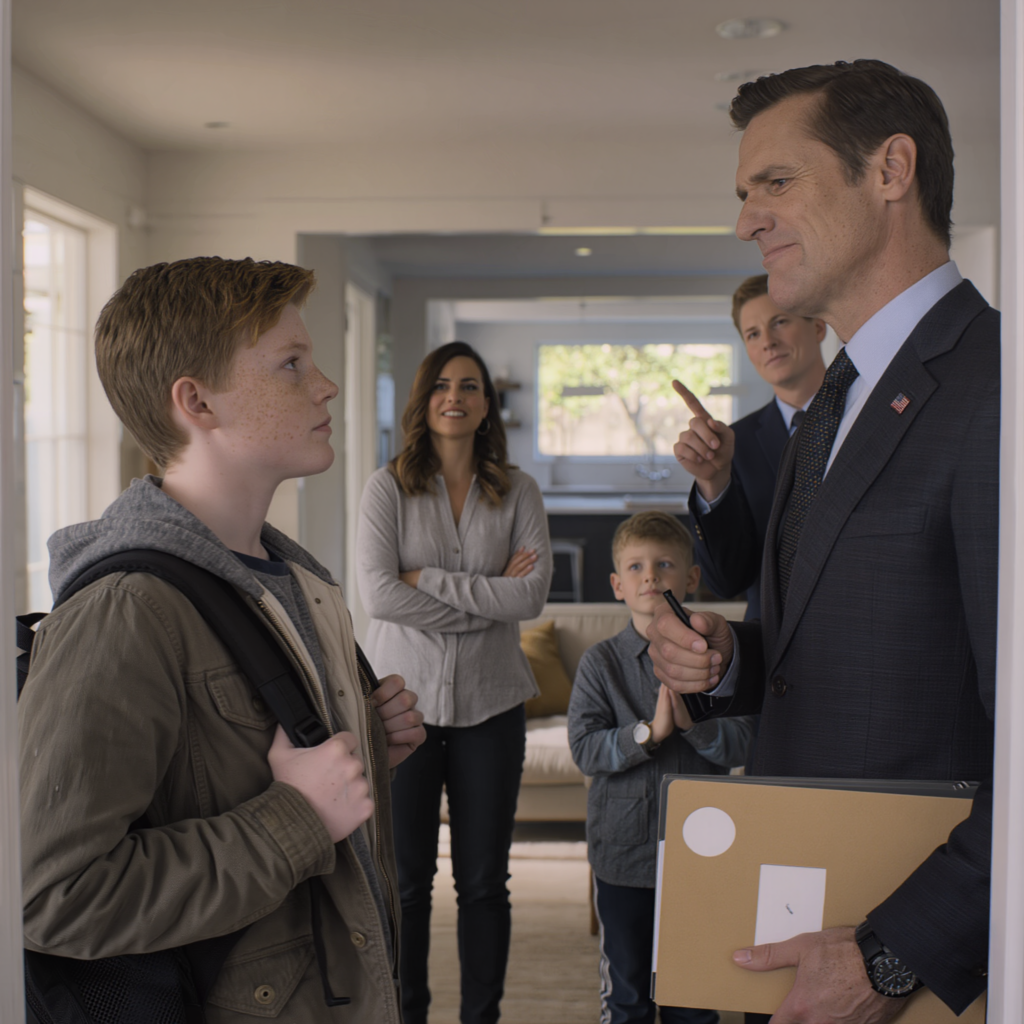
I didn’t need a present—I needed one simple “happy birthday”—but they ate cake without me, then told me to “stop being dramatic”… and the moment I went back to that street, I knew I was about to see their real faces.
The first thing I noticed was the oak tree.
It was still there, still leaning over the curb like it owned the whole block, branches rattling in the late-afternoon wind. Two houses down, someone had clipped a tiny American flag to their mailbox, and the red and blue snapped like it was arguing with the sky. A flag magnet sat crooked on the back of the car in front of me, sun-faded at the edges, like it had been there so long nobody questioned it anymore.
Inside my borrowed sedan, the air smelled like cheap iced tea and sun-warmed vinyl. Somewhere nearby a porch speaker played Sinatra low—soft brass, lazy confidence—like the neighborhood wanted to pretend nothing ever changes here.
Then I saw it.
The FOR SALE sign stabbed up from my parents’ lawn like a dare.
I sat with both hands on the wheel, watching the front porch I used to tiptoe across, and I felt my stomach drop in the quietest way. Going back doesn’t just bring you to a place. It brings you back to a version of yourself you thought you’d outgrown.
And on that street, under that oak tree, I understood I wasn’t here for closure.
I was here to see what they’d do when they thought I wasn’t watching.
Let me back up.
I was seventeen when I started counting down the days until my eighteenth birthday. Not because I was excited to be an adult, but because I knew that was the day I could finally leave.
My name’s Ryan Lane, and I grew up in Maple Glen, Ohio, in a house that looked picture-perfect from the outside. Two stories. White shutters. A big oak tree in the front yard. The kind of place a realtor would call “charming” and a neighbor would call “good bones.”
Inside, it always felt like I was breathing someone else’s air. Like I’d been invited into a life that didn’t want me, and everyone was just waiting for me to understand I wasn’t supposed to stay.
My brother Mason is two years younger than me. And somehow he’s always been the golden boy.
I don’t mean that in a petty older-brother way. I mean he could crash the family car into the mailbox and my parents would ask if he was feeling okay. Meanwhile, when I forgot to vacuum before dinner once, my dad grounded me for a week and acted like I’d embarrassed him in front of the entire country.
Growing up, I learned to live quietly.
In our house, the volume of your footsteps mattered. The way you closed a cabinet mattered. Whether your laugh carried down the hall mattered. I learned to move like I was trying not to disturb anything, including my parents’ opinion of themselves.
My dad was the kind of man who measured people by what they owned. Car, watch, shoes, the neatness of your lawn. He wore a silver watch with a heavy band that clicked against the table whenever he put his hand down. That sound—metal on wood—was like a warning. If his watch hit the table hard, it meant he was annoyed. If it hit twice, it meant you were about to get blamed for something.
Mason knew how to read that sound like it was a language.
I did too.
The difference was, Mason learned how to use it.
My mom was quieter. She didn’t slam doors or shout. She had this way of looking right through me, like I was someone else’s kid who wandered into the wrong house. She’d smile at Mason like the sun had risen just for him, and then glance at me like she was trying to remember where she’d seen me before.
That was the first hinge in my life, the one I didn’t recognize until years later: in that house, love was a spotlight, and I was always standing just outside the beam.
Mason, though, had the effortless charm. The easy smile. The warm, “Aw, come on” voice that made adults laugh instead of correct him. He was the miracle baby after a series of miscarriages. The one who made it.
I think my parents decided right then and there that he was special, and everything else—me included—became background.
I still tried.
I got good grades. I stayed out of trouble. I worked part-time stocking shelves at Kroger to save for college because I already knew they weren’t going to help. My friends talked about campus tours and dorms and meal plans like it was a normal thing. I learned to nod and smile and pretend I wasn’t calculating the price of everything in my head.
Every time the conversation in our kitchen veered toward my future, my dad would grunt and say, “You’re smart. You’ll figure it out.”
It sounded encouraging if you didn’t know him.
But what it meant was: Don’t ask us.
Mason, on the other hand, got a new laptop for his sixteenth birthday because he “needed it for school,” even though he mostly used it to play games and scroll TikTok.
I remember asking my mom if I could borrow it once to fill out college applications.
She didn’t even look up from the counter.
“Ask your brother,” she said.
So I did.
Mason didn’t look up either.
“No,” he said, like he was saying the weather.
I stood there with my application paper in my hand, feeling stupid for asking.
That was another hinge, quieter but just as sharp: I realized I couldn’t even borrow a future in that house.
There were hundreds of little moments like that.
My soccer games where I scanned the bleachers and saw empty space. My report cards that got a quick “nice” while Mason’s B-minus got a full pep talk about how grades don’t define him. The way my mom would buy Mason his favorite cereal and tell me we were out of money when I asked for new socks.
One summer, when I was fourteen, I got strep throat so bad I couldn’t swallow water without crying. My dad drove me to urgent care, but he spent the whole ride talking about how my coughing was “dramatic,” and the entire time his watch clicked on the steering wheel like a metronome counting down my patience.
In the exam room, the nurse asked if I was okay.
My dad answered for me.
“He’s fine,” he said. “He just makes everything bigger than it is.”
I remember thinking: If I disappeared, would they even notice the quiet?
That thought scared me.
Then it became a plan.
So when my eighteenth birthday finally came around, I wasn’t expecting much. Maybe a card. Maybe a family dinner. I didn’t even expect a gift.
I just wanted a moment.
One simple “happy birthday.”
Some kind of acknowledgement that I’d made it through eighteen years in a house that barely tolerated me. That maybe, just maybe, they saw me.
My birthday landed on a Saturday. I didn’t have to work, so I woke up a little late and came downstairs expecting—at minimum—a smile.
What I got instead was my dad in the kitchen, tying a bow onto a sleek black box, and Mason bouncing on his heels like a kid on Christmas morning.
I stood there half asleep, watching this little moment between them like I was intruding.
My mom turned around with a big smile and said, “Perfect timing. Come on, Mason. Open it.”
No one looked at me.
No one even noticed I hadn’t said a word.
Mason ripped into the box and let out a fake gasp like he’d just won the lottery. Inside was a silver watch—expensive-looking, leather band, Roman numerals, the kind of thing my dad loved because it looked like status without needing to be explained.
“Oh my God, Dad. This is so sick.”
Mason grinned, slipping it onto his wrist.
“Now I don’t have to borrow your old one anymore.”
My dad laughed and ruffled his hair.
“Well, you’ve earned it, kid. You’ve been working so hard lately.”
Hard.
The kid’s biggest accomplishment that week was making it to second base with some girl in his chemistry class.
I stood there frozen, waiting for someone to remember the actual reason the day mattered.
My mom finally glanced over at me and said, “Don’t look so sour, Ryan. It’s not always about gifts. When you’re older, you’ll understand that what matters is who you become, not what you get.”
It hit me like a slap.
She said it in that calm, condescending voice she always used when she wanted to seem wise, like I was some selfish kid who didn’t get it.
I tried to nod, to play along, but my throat tightened.
“I thought we were having cake,” I mumbled.
“Oh, we did that earlier,” Mason said casually. “While you were sleeping.”
I blinked.
“You had cake without me?”
“It was just a small thing,” my mom said quickly. “Nothing big.”
The smell hit me then, faint but unmistakable—vanilla frosting, the last trace of sugar hanging in the air like a joke.
I looked at the sink and saw a plate with crumbs. A fork. A smear of icing like someone had wiped it clean.
“Whose name was on it?” I asked.
There was a silence—just a beat too long.
Then Mason smirked and said, “Mine. I mean, it was a joint thing, but it’s not your birthday. Don’t be dramatic.”
My dad snapped, “It’s just a cake.”
I wanted to scream.
I wanted to throw the plate.
I wanted to ask how you forget your own kid’s birthday and then act offended when he notices.
Instead, I laughed.
It was sharp and short and didn’t sound like me.
I laughed because if I didn’t, I was going to cry right there in front of them, and I didn’t want to give them the satisfaction.
Mason raised an eyebrow like I was the crazy one. My mom gave me that look—pity and disappointment—like I was ruining a perfectly good day.
That was the hinge.
That was the moment I stopped hoping they’d wake up and see me.
That night I didn’t even bother turning the light on when I went up to my room. I sat on my bed for a long time, just staring at the floor, trying to swallow the lump in my throat.
I kept thinking: They’re never going to love you the way you want them to.
It doesn’t matter what you do.
It doesn’t matter how hard you try.
You’re never going to be Mason.
So I made a promise.
Not out loud.
Not in some dramatic speech.
Just a quiet wager with myself that I would stop handing them my time and begging them to treat it like it mattered.
If they couldn’t give me two words—happy birthday—then they didn’t deserve the rest of my years.
I grabbed my backpack and stuffed it with a hoodie, a water bottle, a few granola bars, and the sixty dollars I had stashed in an envelope in the back of my sock drawer. I didn’t have a plan.
Not really.
But I had my ID, a charger, and a bus schedule I’d printed weeks ago when I still believed “someday” was a real thing.
At midnight, while the house was quiet and everyone was asleep, I slipped out the back door and didn’t look back.
I told myself I’d stay gone for a day or two. Crash at the church shelter downtown. Find a part-time job. Figure it out.
I didn’t know.
I just knew I couldn’t stay.
The bus station smelled like stale coffee and old air. A TV in the corner played the weather on mute. A flag hung behind the ticket counter, and the cloth drooped like it was tired too.
I sat on a plastic chair and watched people come and go, carrying duffels and backpacks and grocery bags like their whole lives were packed into whatever they could lift.
Nobody asked me where my parents were.
Nobody asked me why I looked like I’d been hollowed out.
That was the first time in my life being invisible felt like relief.
Two weeks later my phone buzzed with a number I hadn’t seen in days.
My dad.
I let it ring the first time. The second. The third.
On the fourth call, I answered.
Before I could say anything, his voice came through, rough and low.
“Your room’s still here,” he said. “Please pick up. Just tell me where you are. Please.”
Something inside me shifted.
Not because he sounded worried. Not because he sounded sad.
Because for the first time, he sounded unsure.
And that scared me more than anger ever had.
I didn’t go back.
Not that week.
Not the next.
Not after the voicemail where he said, “We can talk about it. Just come home.”
Two days later he called again, quieter and sharper.
“I don’t know what you think you’re proving, Ryan,” he said, “but this isn’t how family works. You don’t just vanish.”
That part made me laugh under my breath.
Ironic, considering I’d spent my entire life feeling like a ghost in that house.
By then, the missed calls were stacking up.
I remember one night in the shelter, my phone buzzing over and over in my pocket like an angry insect. When I finally checked the screen, I saw the number.
Twenty-nine missed calls.
All from my dad.
Not one text.
Not one “Are you okay?”
Not one “I’m sorry.”
Just the same demand, repeated until the number looked like a threat.
That became my number.
Twenty-nine.
Not because it meant love.
Because it meant control.
I bounced around.
First at the church shelter, where the volunteer at the desk gave me a paper cup of water and didn’t ask questions. Then at this small room-for-rent setup run by a retired mechanic named Lynn, who had a soft spot for strays—both dogs and people.
Lynn had forearms like tree trunks and a voice like gravel. His garage smelled like oil and rust and old tools, but it was warm. He’d walled off a corner with plywood and hung a heavy curtain for privacy.
“That’s your spot,” he said, pointing. “Keep it clean. Don’t bring trouble. Pay what you can.”
I nodded.
He didn’t ask why I was alone.
He didn’t ask where my parents were.
He just handed me a key to the side door and said, “There’s iced tea in the fridge. Don’t touch my root beer.”
It was the kindest thing anyone had said to me in weeks.
I found part-time work unloading trucks at a shipping warehouse. My hands got scraped and sore. My back ached in ways I didn’t know it could. At night, I’d sit on my mattress behind the curtain and listen to Lynn’s radio hum old songs.
Sometimes Sinatra.
Sometimes country.
Always something steady, like a heartbeat.
Between shifts, I lived at the public library, using computers that timed out every thirty minutes. I filled out college applications in chunks, saving my work like my life depended on it.
I didn’t tell my parents where I was.
I didn’t want them to find me until I had something to show for it. Something they couldn’t pretend was a “phase.”
But eventually, they found me anyway.
It was Mason who showed up first.
I was walking out of the library one afternoon when I saw him leaning against a car that was definitely too nice for him. New model. Shiny black paint. Leather seats. He stared at his phone like he was bored.
He hadn’t seen me yet.
My instinct was to turn and bolt, but curiosity pinned me in place.
He spotted me a second later and smirked like I was late to something I didn’t know I’d been invited to.
“There you are,” he said, slipping his phone into his jacket. “You look like crap, bro.”
“Thanks,” I said flatly.
“Seriously though, Mom’s freaking out. Dad’s being weird. You made your point. Okay, come home.”
“I’m not coming home.”
He sighed like I was the stubborn one.
“Come on, man. You had your little tantrum. Now everyone’s waiting for you to crawl back so things can go back to normal.”
Normal.
The word hit me like a brick.
“You mean where my birthday cake had your name on it?” I asked. “That kind of normal?”
He shrugged like I’d brought up the weather.
“It was a mix-up,” he said. “You always take things so seriously. They didn’t mean anything by it.”
“You’re right,” I said. “They never mean anything by it. That’s the problem.”
His smile dropped.
“Look,” he said, voice tightening, “I don’t know what kind of sob story you’re telling yourself, but you’re not the only one with problems, okay? You don’t see me running away.”
“No,” I said. “You just see the world bending so you don’t have to.”
That got to him.
He pushed off the car and stepped closer, the silver watch my dad bought him flashing on his wrist when it caught the light. The Roman numerals looked almost smug.
“You’re acting like you’re some martyr,” he snapped. “Dad’s been calling you nonstop.”
“Twenty-nine times in one night,” I said before I could stop myself.
Mason blinked.
“What?”
“Twenty-nine,” I repeated, calm now. “That’s how many missed calls I had. Not a single ‘happy birthday’ that morning. But twenty-nine calls when you thought I embarrassed you.”
His jaw tightened.
“You’re twisting it,” he said.
“No,” I said. “I’m finally seeing it.”
He rolled his eyes and pointed toward the passenger seat of his car.
“Get in,” he said. “Let’s just talk it out. Mom made your favorite lasagna. You come home, everyone stops being weird.”
My favorite lasagna.
Like love could be cooked up and served as a bargaining chip.
“I’m not getting in your car,” I said.
He scoffed.
“You’re unbelievable,” he said. “Fine. Keep sleeping in whatever dump you’re sleeping in. Just don’t expect a parade when you finally come back.”
I nodded slowly.
“Yeah,” I said. “Did they tell you what they said the night I left?”
He didn’t answer.
I didn’t expect him to.
“Tell them I’m doing fine,” I said, turning away. “And if they’re really so worried, they can stop calling my number and start thinking about why I stopped picking up.”
A week passed, then two.
I started hearing less from them. No more voicemails. No more texts.
It was like they’d tried being concerned, got bored, and went back to whatever version of family life worked best without me.
I figured that was the end of it.
Until I got an email.
Not from my parents—from my high school counselor, Mrs. Dero.
It was short and awkward, like she didn’t know whether to be concerned or polite. She said she hoped I was safe and okay, but she wanted to let me know my transcripts had been requested and withdrawn.
According to the system, my parents had contacted the school and said I would not be attending college and to cancel any further application correspondence.
I sat there in the library staring at the screen, not breathing.
I read it again, then a third time.
They tried to erase me.
I called the school immediately, heart thudding hard enough to make my fingers shake. Mrs. Dero picked up.
“Ryan?” she said, surprised.
“Please don’t hang up,” I said too fast. “I didn’t withdraw. I didn’t ask anyone to cancel anything.”
There was a pause.
“I’m so sorry,” she said, and the apology in her voice sounded real. “Let me pull up the record. One moment.”
I stared at the carpet, listening to the tiny click of keys on her end.
“Okay,” she said finally. “It looks like the request came from a parent email address on file.”
“That’s not my decision,” I said, trying to keep my voice steady. “I’m still applying. I need you to flag that. I need you to reverse whatever you can.”
She didn’t question it.
“Let’s fix it,” she said.
For the first time in my life, an adult spoke to me like my future mattered.
It took two days of calls and forms and awkward explanations, but we untangled most of it.
Most.
A few deadlines had already passed. I missed a scholarship opportunity I had a real shot at.
I sat on my mattress behind Lynn’s curtain that night and stared at my hands, feeling something inside me go heavy.
It wasn’t sadness anymore.
It was clarity.
This wasn’t parenting.
It was sabotage dressed up as discipline.
A month later I got a letter in the mail.
A real letter. Paper. Envelope. No return address. Just my name scrawled in my dad’s handwriting.
Inside, there was no apology.
There was a list.
A literal bullet-point list of things I needed to do before we could “talk about” me coming home.
Stop blaming others for your unhappiness.
Apologize for walking out and ghosting your family.
Recognize the sacrifices we made for you.
Understand that we do what we do out of love.
I read it in silence.
Then I laughed, because what else could I do?
It wasn’t a letter.
It was a contract.
A way to make me the problem again.
I crumpled it, tossed it into the trash, and told myself for the hundredth time I was done.
Then came the envelope Lynn handed me one evening like it weighed more than paper should.
He said someone had come by earlier, asked if Ryan lived here, and left it without saying much.
Inside was a formal notice from an attorney’s office. It said I was being removed as a dependent from my parents’ taxes retroactively. It said I was no longer part of their household. It said I had until the end of the month to collect any remaining personal belongings from their property before it would be disposed of.
There was a sticky note attached.
Just one line, in my mom’s handwriting:
“This is what consequences look like.”
I didn’t cry.
I didn’t even feel angry the way I expected.
Something inside me just went still, like a door finally latching.
For two days after that, I barely spoke.
Lynn noticed. He didn’t press. He just slid an extra sandwich across the workbench and said, “Whatever it is… it won’t last forever. Not if you don’t let it.”
I nodded, but I didn’t believe him.
Rock bottom doesn’t always look like a dramatic fall.
Sometimes it’s quiet. A dull ache that settles in your chest and never leaves.
It’s walking home after a double shift with your boots soaked through, realizing you don’t have a home—just a garage with a curtain.
It’s sitting there at three in the morning with your hoodie pulled over your face, knowing your family has written you off like a bad investment.
That week I skipped two shifts.
I didn’t answer when Lynn knocked.
I didn’t check my email.
Didn’t eat much.
Didn’t sleep.
I just lay there listening to the wind shove against the garage door, wondering what I was even doing anymore.
Then something stupid saved me.
A book.
It was buried in the bottom of my backpack: a worn-out, dog-eared copy of Into the Wild by Jon Krakauer. I’d read it three times already. That night I flipped it open and landed on a sentence I’d underlined years ago in red ink.
Happiness is only real when shared.
It should’ve made me feel worse.
Instead, it made me sit up.
Because I realized I’d been trying to share my life with people who never wanted it.
I kept handing over pieces of myself, hoping someone would finally say, “We see you. You matter.”
But they never would.
And the moment I stopped begging, I started building.
The next morning I went back to work.
I apologized to my supervisor for missing shifts and offered to take the graveyard slot for the next two weeks to make up for it.
He didn’t ask questions.
He grunted and handed me a badge for the overnight crew.
The work was harder—heavier boxes, colder nights—but I didn’t care.
I needed the weight of something real.
That was the beginning of my rebuild.
Quiet.
Simple.
Mine.
Over the next few months I fell into a rhythm: wake up, work, read, sleep, repeat. I started putting aside every extra dollar. I cut out anything unnecessary. I stopped using data on my phone to save on the bill.
Lynn noticed and started slipping me extra chores to earn credit toward rent.
Sometimes he’d toss me a twenty and say it was for groceries, pretending I hadn’t just scrubbed his entire truck engine clean.
One night, after I’d been up for nearly twenty hours, he pointed at my hands.
“You keep that up and you’ll break yourself,” he said.
“I can’t afford to,” I answered.
He looked at me for a long second.
“Yeah,” he said quietly. “I know.”
I applied to community college again, this time without my parents’ help, and paid the fee myself.
I wrote an essay so honest I cried after I hit submit.
I didn’t polish it into something pretty.
I wrote about growing up invisible. About the way silence can scream louder than words. About rebuilding yourself from scratch when nobody hands you the tools.
Slowly, things shifted.
One night while I was mopping the warehouse floor, I overheard two guys from logistics complaining about a software glitch.
“Every time we scan this batch,” one of them said, “it duplicates the order and messes up the route.”
“I hate this system,” the other guy groaned.
I’d been dabbling in a free Python course late at night, half because I was curious, half because I needed something to remind me I was more than a pair of hands.
I cleared my throat.
“I think it’s the input field,” I said. “If you force it to validate the barcode length, it won’t create a duplicate record.”
They stared at me like I’d spoken another language.
“Who asked you?” one of them said, but it didn’t sound cruel. It sounded surprised.
“I’m just saying,” I said, shrugging.
Two days later, one of them pulled me aside.
“Hey,” he said, softer. “That thing you mentioned? It worked.”
From then on, people started coming to me when screens froze or printers jammed.
No title.
No big speech.
Just small moments where someone said my name and meant it.
It was a strange feeling.
The kind that makes you sit with it and whisper, Maybe I’m not just background noise.
My first big win came in early summer.
I got an email from the community college.
Accepted.
With a scholarship.
Not a full ride, but enough to cover tuition if I kept working part-time.
I stared at the screen, rereading the word congratulations over and over like it might vanish if I blinked too hard.
Lynn let me use his kitchen that night to bake a boxed cake.
It came out lopsided and slightly burned, but I didn’t care.
I wrote my own name on it in blue frosting.
Ryan.
Just that.
No shared celebration.
No forgotten candle.
No lecture.
Just me, a beat-up garage, and the first piece of joy I’d built with my own two hands.
When I cut a slice and took the first bite, the sweetness hit my tongue and I felt my chest tighten for a different reason.
Because I realized something: I’d wanted them to celebrate me.
But I didn’t need them to.
I could do it myself.
And that, quietly, was the beginning of freedom.
I didn’t call my parents.
I didn’t tell them.
But in Maple Glen, people talk.
A week later, at the grocery store, I ran into an old neighbor, Mrs. Kavanaugh, who used to sneak me cookies when my mom wasn’t looking.
She smiled wide when she saw me.
“I heard you’re going to college,” she said. “Your mom must be so proud.”
I nodded.
“Yeah,” I said. “Must be.”
I could’ve told her the truth.
I could’ve said, She didn’t even say happy birthday.
I could’ve said, They tried to cancel my future.
Instead, I just kept my voice calm and let the lie sit there.
Because I wasn’t trying to win pity.
I was trying to survive.
Later that week I got a call from an unknown number.
I let it go to voicemail.
It was my mom.
She didn’t cry.
She didn’t yell.
She just said, “We heard about school. Glad you’re doing well. I hope you’ll remember where you came from.”
I replayed that line five times.
Where I came from.
Like I was a stray who needed to return to a kennel.
But I didn’t feel angry.
I felt free.
By the end of summer, I moved out of Lynn’s garage. I found a shared apartment near campus with two roommates who kept to themselves and didn’t ask questions.
I started classes and landed a part-time IT job at the school help desk.
It wasn’t glamorous, but it paid the bills.
And little by little, I began building something that looked suspiciously like a life.
I still had scars.
Emotional ones.
I still flinched when people raised their voices. I still second-guessed compliments. I still caught myself apologizing for taking up space.
But I was learning.
Healing isn’t always loud.
Sometimes it’s just drinking coffee in a quiet room and realizing you’re not afraid to be seen anymore.
One night I opened a new notebook and wrote down a list.
Not of goals.
Of truths.
Things no one could take from me.
You don’t need permission to become someone they never imagined.
Your worth isn’t measured by someone else’s disappointment.
You can start over, even when they say you can’t.
Family isn’t who you’re born to. It’s who roots for you when nobody’s watching.
I closed the notebook, turned out the light, and slept better than I had in years.
I should’ve known it wasn’t over.
Because just when I thought I’d finally cut the last thread, something pulled me straight back.
It started with a message request on Facebook.
I hadn’t used the app in months—maybe longer. I kept the account alive for boring reasons: logins, confirmations, the occasional update I didn’t ask for.
The sender’s name made my chest go tight.
Mrs. Langford.
My parents’ old neighbor. The one with the garden that used to spill into our yard. She was always kind but distant, friendly in the way suburban neighbors are—cordial waves, polite holiday cards, whispered gossip across fences.
I hadn’t spoken to her in years.
Her message was simple.
Hey Ryan, I wasn’t sure if I should say anything, but I thought you had the right to know. Your parents listed your childhood home for sale. The sign just went up this week. Hope you’re doing well.
I stared at the screen.
Then reread it.
The house was for sale.
For a second I didn’t feel anything.
Then something colder slid into place.
I’d always assumed they’d sell eventually. Downsize. Move somewhere with gates and rules and a neighborhood newsletter that acted like a court order.
But the timing didn’t sit right.
Not after cutting me off.
Not after trying to cancel my future.
Not after that sticky note.
So I did what anyone would do when curiosity turns into a bruise.
I looked up the listing.
There it was: an overexposed photo of the porch, white shutters cleaned up, the oak tree still casting a crooked shadow across the lawn.
The description was flowery and fake.
Charming family home with rich character, lovingly maintained for over two decades. Quiet neighborhood. Custom finishes.
I scrolled through the photos.
Living room.
Kitchen.
Master bedroom.
Then the one that made my breath catch.
The room that used to be mine.
They’d turned it into a guest suite.
Neutral walls. Beige bedding. Generic art prints.
Every trace of me was gone.
No posters.
No desk.
No shelf of beat-up paperbacks.
No hint that someone had spent eighteen years trying to exist in that space.
They didn’t just push me out.
They edited me out.
That was the hinge.
That was the moment my curiosity turned into a vow.
I wasn’t going back to beg.
I was going back to see the truth.
So that weekend I borrowed a decent shirt from my roommate, made myself look like any other potential buyer, and scheduled a tour online under a shortened name.
I didn’t know what I was expecting when I pulled up to the curb in a borrowed car.
A rush of emotion.
Nostalgia.
Bitterness.
But mostly I felt numb.
The porch still creaked the same way it used to. The front door still had the scratch near the bottom from the time I tried to sneak in a stray cat.
The agent—Sasha, all bright teeth and glossy hair—smiled like she was selling a dream.
“So the sellers are really motivated,” she chirped, flipping her clipboard. A tiny flag sticker was stuck to the back of it, probably some company branding, but it made my stomach twist anyway. “They’re looking for a quick close. Downsizing now that their youngest is off to college.”
Their youngest.
Like I didn’t exist.
I nodded politely.
I barely listened.
My focus was on the walls, the hallway, the way the air felt wrong because it was missing the parts of me they’d erased.
In the living room, the corner where my dad’s chair used to sit was empty. The space looked staged now—neutral pillows, a throw blanket folded like a magazine cover.
Sasha chatted about countertops and natural light.
I watched the baseboards.
I watched the family photos—carefully curated. Mason in a cap and gown. Mason holding a trophy. Mason with my mom, all smiles.
Me?
If I existed at all, it was as a blur in the background of someone else’s picture.
When we got to the backyard, I stopped.
The fence was newer.
The treehouse I’d built with my uncle when I was twelve—back when I still had hope—was gone.
Nothing left but disturbed dirt and a few rusty nails in a log.
“I’ll give you a minute,” Sasha said, sensing something in my silence.
I nodded and walked toward the back fence, hands in my pockets to keep them from shaking.
That’s when I saw it.
Near the patio steps, half-hidden under a stack of staging props, was a small plastic bin filled with odds and ends they hadn’t packed yet.
A few old keys.
A roll of tape.
And on top, a watch box.
Black.
Sleek.
The same kind of box my dad had wrapped that morning in the kitchen.
My throat went tight.
I didn’t touch it.
I didn’t open it.
I didn’t need to.
Just seeing it there—casually tossed like it didn’t matter—felt like proof.
Not of anything legal.
Of something worse.
In that house, even time was disposable, as long as it belonged to me.
That night, I sat in my car long after the engine cooled.
And I knew it wasn’t just curiosity anymore.
It wasn’t grief either.
It was clarity.
They wanted to pretend I never existed.
Fine.
Then I’d make sure they had to live with the consequences of the version of me they created.
I didn’t want a scene.
I didn’t want anything reckless.
I wanted something slow and precise.
So I started planning.
First step: learn what was true.
Over the next week I did the boring kind of digging—the kind nobody makes movies about. Public property records. Filing dates. Paper trails that didn’t line up.
What I found was a crack.
The home note wasn’t paid off.
And they were behind.
Not years.
Just enough to explain why the FOR SALE sign felt less like a choice and more like a scramble.
I didn’t feel satisfaction.
I felt a grim kind of recognition.
Of course they were selling.
The image needed protecting.
Second step: get help.
I called someone I hadn’t spoken to in a long time.
Milo.
An old classmate who used to run the tech club and now worked in compliance—good at paperwork, good at patterns, good at spotting what people try to hide.
We weren’t close.
But I knew two things.
He hated bullies.
And he owed me a favor from way back when I covered for him during a mess that could’ve ruined his life.
We met for coffee near campus.
Milo showed up in a hoodie that looked like it cost more than my first month’s rent.
He took one look at my face.
“Okay,” he said. “Tell me the short version.”
I gave him a version I could say without my voice breaking.
“I need to know what they’re not saying about the house,” I told him. “If they’re selling like everything’s perfect… it’s not.”
Milo stared into his coffee.
“You want me to break anything?” he asked, half-joking.
“No,” I said immediately. “Nothing like that. Just… what’s on paper. What’s public. What’s missing.”
He nodded.
“Okay,” he said. “Give me a couple days.”
When he came back, he didn’t look excited.
He looked annoyed.
“Your parents are playing games,” he said, sliding a folder across the table.
Inside were copies of disclosure summaries and old service notes.
A long-running plumbing issue in the basement that had been patched and covered instead of fixed.
A record of water damage that got re-labeled as “minor moisture.”
A repair estimate—an actual written estimate—attached to a contractor email.
$7,840.
I stared at the number.
“That’s… real?” I asked.
Milo nodded.
“Real enough that if a buyer finds out after closing, it becomes a nightmare,” he said. “And real enough that a listing shouldn’t pretend it doesn’t exist.”
I felt my mouth go dry.
It wasn’t just that they were selling.
It was how they were selling.
Cover it.
Smile.
Move on.
It was the same strategy they used with me.
Erase the problem.
Call anyone who notices “dramatic.”
That was the hinge that turned my plan into something firm: if they could hide damage in a basement, they could hide damage in a family.
And they had.
Meanwhile, another opportunity landed in my lap—one I’d been quietly earning without even realizing it.
My grades and work-study hours made me eligible to transfer into a stronger scholarship program.
The school asked if I’d speak at fall orientation as a first-generation student who’d worked his way up.
I said yes.
Not because I wanted applause.
Because I wanted my name said out loud in a room full of people, without me having to beg for it.
The day of orientation, the auditorium smelled like fresh paint and floor polish. A huge American flag hung behind the stage. It was the kind of detail most people don’t notice.
I noticed.
Because in my life, flags always showed up around things people wanted to make look honorable.
I stood in the wings waiting for my turn, palms sweating, heart thudding.
A staff member handed me a small bottle of water.
“You’ll be great,” she said.
No one had ever said that to me in my own kitchen.
When I stepped onto the stage, the lights were bright enough to make the audience blur.
I took one breath.
Then another.
And I told them the truth.
Not the messy details.
Not the private wounds.
But the shape of it.
How you can come from somewhere that doesn’t see you and still become someone.
How you can build a life with your own hands.
How it’s okay to be proud of yourself even when nobody claps.
I saw heads nod.
I heard a few soft laughs.
I felt something in my chest loosen.
Afterward, a local news crew filmed a short segment.
I didn’t think it would matter.
Then the article hit.
A few days later, the college posted a full profile on their website—photos, an interview, the whole thing.
From “invisible” to Dean’s List: Ryan Lane’s journey from abandonment to academic momentum.
It was dramatic.
A little too dramatic.
But it was real.
And it spread.
People shared it. Old classmates saw it. Teachers. Neighbors.
The social fallout came quietly.
Aunties texting cousins.
Old church friends whispering.
People who’d never asked me how I was suddenly asking what happened.
I saw my name in places it had never been spoken kindly.
I also saw the backlash.
In Maple Glen, people love a neat story.
A kid goes to college.
Parents are proud.
Everyone smiles.
My story wasn’t neat.
So my parents tried to make it neat by making me the villain.
I found out when a friend sent me a screenshot of a comment on the college post.
“This article is full of exaggerations,” someone had written. “Some kids just don’t appreciate how much their family sacrifices for them.”
It was my mother.
She didn’t sign her name, but I knew her tone like I knew the sound of our porch creaking.
That was another hinge.
Not because the comment hurt.
Because it proved something.
Even with my name on a scholarship certificate, she still needed me to be the problem.
Around that same time, Mason started applying to transfer universities.
He talked about it online like it was inevitable, like acceptance letters were just paperwork.
He posted selfies.
He posted gym photos.
And in almost every picture, that silver watch flashed on his wrist.
Roman numerals.
Leather band.
A constant reminder that my dad had wrapped time around Mason’s arm and called it “earned.”
I still had old screenshots from years ago—things Mason had said, shortcuts he’d bragged about, little moments of arrogance that felt harmless when you were seventeen and the world bent around you.
I didn’t want to destroy him.
I didn’t want to ruin his life.
But I did want him to understand something he’d never had to understand before.
That consequences don’t always show up with sirens.
Sometimes they show up as a closed door you thought would be open.
So I sent a short, factual note to the right office at the school he wanted—enough to raise questions, enough to make the ground under him shift the way it used to shift under me.
I didn’t celebrate.
I didn’t gloat.
I just… exhaled.
Meanwhile, the house sale was moving forward.
Viewings.
Open houses.
Smiling photos.
And the damage hidden beneath the surface.
I didn’t send anonymous packages.
I didn’t play games.
I did the simplest, most devastating thing.
I made sure the truth landed where it needed to land.
I forwarded the documentation Milo pulled—repair estimate, service notes, the pattern of “minor moisture” language—to the listing broker and the county office that handles disclosure complaints.
No dramatic message.
No threat.
Just facts.
Within days, the listing went quiet.
Then it vanished.
Three days later, the house disappeared from every public search like someone had yanked it off the internet by hand.
In Maple Glen, that kind of silence is loud.
People noticed.
Neighbors talked.
Someone in a local Facebook group posted, “Did the Lane house sale fall through? Anyone know why?”
Another person replied, “Heard there’s water issues.”
Another replied, “Thought they kept that place perfect.”
And just like that, the image started to crack.
Not because I screamed.
Because I let the truth sit in the light.
Now here’s the part I didn’t expect.
They came to me.
Not together.
Separately.
First it was my dad.
He showed up at the campus help desk on a Tuesday morning.
Eyes bloodshot.
Tie loose.
Face drawn like he hadn’t slept in days.
I was behind the counter helping a student reset a password when I looked up and saw him.
For a second, the room tilted.
Not because I missed him.
Because I’d never seen him look small.
He waited until the student walked away.
Then he leaned closer.
“Ryan,” he said, like my name was a foreign word. “We need to talk.”
I stared at him.
Calm.
Steady.
“You mean now that the house listing collapsed and Mason’s transfer plans are shaky?” I said quietly.
He blinked.
“We didn’t know it had gotten this bad,” he said. “You’ve made your point. Okay, we get it.”
“No,” I said. “You don’t.”
His mouth tightened.
“Why are you doing this?” he asked. “Why are you—”
He stopped himself, like he didn’t want to say the word he was thinking.
Like he didn’t want to admit I had power.
I kept my voice low.
“Do you remember my eighteenth birthday?” I asked.
He frowned.
“Of course,” he said.
“Did you say it?” I asked.
He stared at me.
“What?”
“Did you say ‘happy birthday’?” I asked again.
His jaw moved like he was chewing on something bitter.
“We had—” he started.
“No,” I said. “Just answer. Did you say it?”
He didn’t.
He couldn’t.
That silence was louder than anything he’d ever yelled.
I leaned slightly forward.
“You called me twenty-nine times,” I said. “Twenty-nine. Not because you missed me. Because I didn’t obey.”
His face twitched.
“We were worried,” he said.
“No,” I said. “You were embarrassed.”
He swallowed.
“We can fix it,” he said, softer. “Maybe… maybe come home. Let’s talk this through.”
I felt something like a smile touch my mouth—small and cold.
“There is no home,” I said. “You made sure of that.”
He tried again.
“We’re family,” he said.
I looked at him.
“Family doesn’t treat someone like a guest,” I said. “Family doesn’t try to cancel their future.”
His eyes flashed.
“Stop being dramatic,” he snapped.
There it was.
The phrase.
The button they’d pressed my whole life.
I let it sit between us like a dead thing.
Then I nodded.
“Okay,” I said. “We’re done.”
I stepped back.
He didn’t follow.
Two weeks later, my mom came next.
Not in person.
Not with a phone call.
With a sheet of paper slipped under my apartment door like she didn’t want my roommates to see her handwriting.
Ryan, we made mistakes. I see that now, but you’re being cruel. Punishing us like this doesn’t make you better than us. Please. This is your family.
I read it twice.
Then I set it down.
I didn’t respond with paragraphs.
I didn’t argue.
I didn’t explain, because I’d spent my whole life explaining.
Instead, I did something else.
I sent her a photo.
A simple one.
Me standing in front of the college banner holding my scholarship certificate.
Smiling.
And this time, in the corner of the frame, my wrist was visible.
Not Mason’s watch.
Mine.
I’d bought a cheap little watch with my first real paycheck from the help desk job. Nothing fancy. Black band. Clean face. No Roman numerals.
It didn’t look like status.
It looked like mine.
On the back of the printed photo, I wrote:
“This is what consequences look like.”
Then I put it in the mail.
No return address.
No note.
Just the truth, delivered the way she always delivered hers.
Quiet.
Unavoidable.
After that, the rest played out the way money always does when the truth finally catches up.
The house slipped out of their hands.
Mason transferred, but not where he’d planned.
My parents moved into a rental two counties over—smaller, older, the kind of place you don’t post online.
In Maple Glen, the story changed.
Not overnight.
But slowly.
A neighbor would mention the canceled listing.
A church friend would mention the article.
Someone would ask, “Where’s Ryan?”
And for once, my parents didn’t have an easy answer.
They could say I was “dramatic.”
They could say I was “ungrateful.”
But they couldn’t explain why the kid they claimed they loved never came home.
As for me, I kept going.
I graduated with honors.
I started working with a nonprofit that helps first-generation students navigate college without family support. I mentor kids who sit in classrooms feeling invisible, the same way I used to.
I have my own place now.
A dog.
A full fridge.
Friends who choose me.
And not once—not once—have I needed to beg for my own existence.
My payback wasn’t loud.
It didn’t come with slammed doors or screaming matches.
It came with quiet progress.
With showing up.
With building a life brick by brick while they waited for me to collapse.
A few months after everything settled, I drove past that old street again.
The oak tree was still there.
The shutters were still white.
The porch still creaked when someone else stepped on it.
And as I rolled past, I glanced down at my wrist.
My own watch.
Simple.
Steady.
Keeping time the way I wanted it kept.
I didn’t stop.
I didn’t look back.
I just kept driving, letting the neighborhood shrink in the rearview mirror until it became what it always should’ve been—background.
I wasn’t the disappointment in that house.
I was the escape artist they never saw coming.
And the best part is, they’ll spend the rest of their lives pretending they didn’t lose a so
News
I buried my 8-year-old son alone. Across town, my family toasted with champagne-celebrating the $1.5 million they planned to use for my sister’s “fresh start.” What i did next will haunt them forever.
I Buried My 8-Year-Old Son Alone. Across Town, My Family Toasted with Champagne—Celebrating the $1.5 Million They Planned to Use…

My husband came home laughing after stealing my identity, but he didn’t know i had found his burner phone, tracked his mistress, and prepared a brutal surprise on the kitchen table that would wipe that smile off his face and destroy his life…
My Husband Came Home Laughing After Using My Name—But He Didn’t Know What I’d Laid Out On The Kitchen Table…

“Why did you come to Christmas?” my mom said. “Your nine-month-old baby makes people uncomfortable.” My dad smirked… and that was the moment I stopped paying for their comfort.
The knocking started while Frank Sinatra was still crooning from the little speaker on my counter, soft and steady like…

I Bought My Nephew a Brand-New Truck… And He Toasted Me Like a Punchline
The phone started buzzing before the sky had fully decided what color it wanted to be. It skittered across my…

“Foreclosure Auction,” Marcus Said—Then the County Assessor Made a Phone Call That Turned Them Ghost-White.
The first thing I noticed was my refrigerator humming too loud, like it knew a storm had just walked into…

SHE RUINED MY SON’S BIRTHDAY GIFTS—AND MY DAD’S WEDDING RING HIT THE TABLE LIKE A VERDICT
The cabin smelled like cedar and dish soap, like someone had tried to scrub summer off the counters and failed….
End of content
No more pages to load