The cabin smelled like cedar and dish soap, like someone had tried to scrub summer off the counters and failed. A little American-flag magnet held a crumpled grocery list to the refrigerator door, and the old radio on the window ledge kept coughing out Sinatra between bursts of static. Outside, the lake was slate-gray under a bruised sky, the kind of late-season afternoon that made you pour iced tea and pretend it was still warm enough to matter.
We were there for Labor Day weekend, which, in our family, meant two things: pretending everything was fine and pretending we wanted to be together. Jacob’s birthday had landed close enough that my mother insisted we “do it all at once,” like celebration was a batch recipe. He’d been counting down the drive to the cabin, his knees bouncing in the backseat, his voice bright in that way kids have before they learn how adults can dull it.
By the time we arrived, his gifts were already a half-mess on the living room rug—paper, bows, a box crushed at one corner, a dinosaur missing an arm. He’d thanked everyone, because he’d learned manners early. He’d laughed when a toy made a sad clicking sound instead of lighting up, because he’d learned that, too.
The hinge didn’t come with a warning. It never does.
Jessica showed up late, as always, trailing perfume and confidence like she’d rented it by the hour. She breezed in with a bottle of pinot noir and a smile that didn’t warm her eyes, then leaned down to Jacob as if she was about to give him something special.
“Happy birthday, buddy,” she said.
He beamed.
Jessica lifted a gift bag from the coffee table, peeked inside, and made a face. “Who buys a kid something this cheap?”
“It’s what he asked for,” my mother said quickly, too quickly.
Jessica’s laugh was soft and nasty. She reached into the bag, pulled out the remote-control car, and turned it over like it was contaminated.
“This is going to break in five minutes,” she announced.
Before anyone could react, she pressed the car down against the edge of the fireplace hearth—just enough to make the plastic crack. A sharp little snap. Jacob’s smile faltered, confused, like his brain was trying to compute why an adult would hurt something he loved.
“Oh my God,” Uncle Mark chuckled from the couch, already amused. “It’s just a toy.”
Jessica shrugged and tossed the car back into the bag. It landed hard, a dull thump that made Jacob flinch.
Then she stepped backward—careless, theatrical—and her heel came down on the corner of the dinosaur set. The box caved with a crunch.
“Oops,” she said, and the room rewarded her.
Laughter, again, like she’d performed a trick.
Jacob’s eyes went shiny. Not tears yet—he was fighting those—but the surface of them changed, like glass turning to water.
“Hey,” I started, my voice rising with instinct.
My mother cut me off with a bright little sound. “Jessica, honey, don’t tease him. He’s sensitive.”
Sensitive. That was our family word for anyone who didn’t swallow pain fast enough.
Jacob bent down and tried to fix the dinosaur box with his small hands, pressing the cardboard back into shape like he could undo what had been done. I watched his jaw tighten the way mine used to, and something in my chest went cold.
Because here was the promise I’d made without ever saying it out loud: I will not let him become me.
That promise was going to come due.
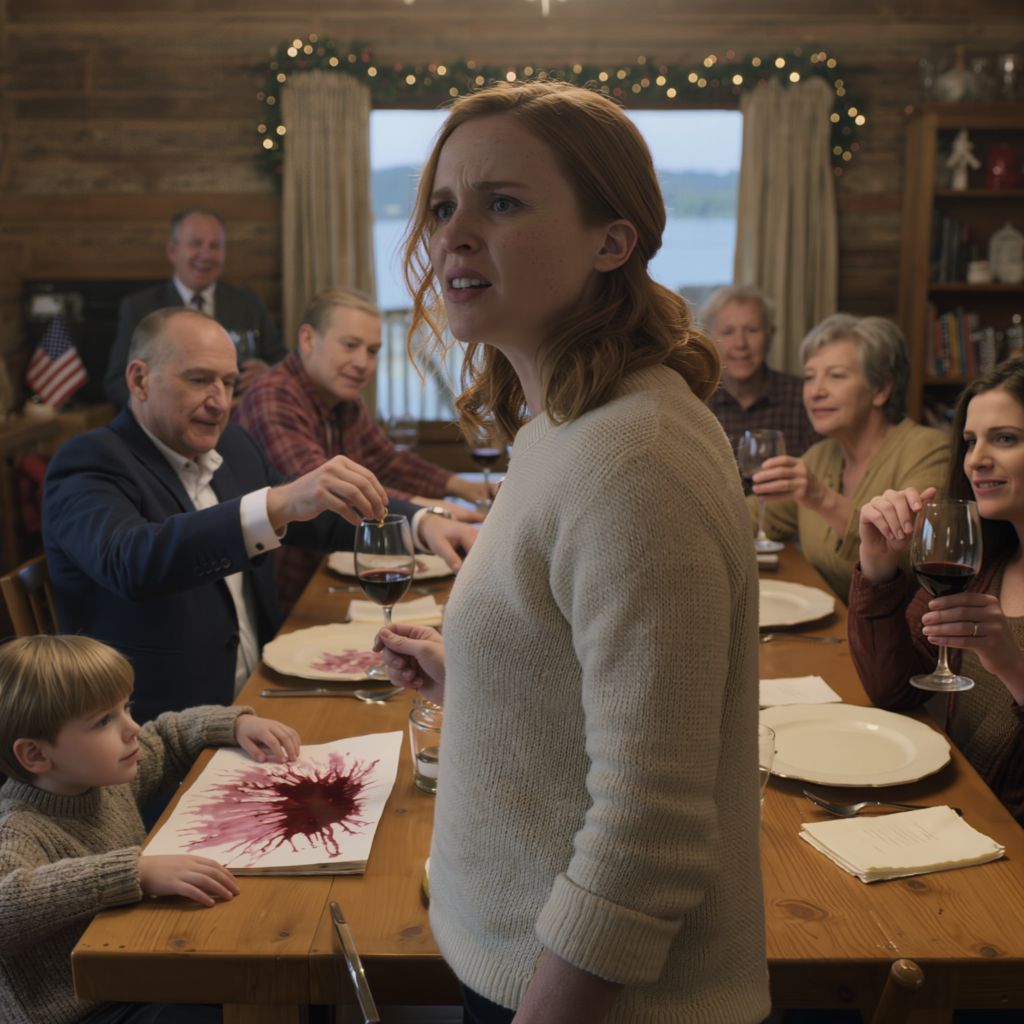
Jacob slid away from the gifts and went to the table, where his painting was drying. He’d spent three days on it in the weeks leading up to this weekend, hunched over a cheap watercolor set at our kitchen counter, tongue poking out in concentration, painting the lake outside the cabin because he wanted to give it to Grandpa. It wasn’t a “craft.” It was devotion.
The first drop of wine hit the paper at exactly 4:15 in the afternoon.
Jessica didn’t spill it.
She poured it.
She stood over my six-year-old son, tilting her glass with casual, almost bored precision, as if she was watering a plant. The deep red liquid seeped into the blue sky he’d painted, bleeding across the page, warping the edges, turning his hard work into a soggy, ruined mess.
“He needs to learn the world doesn’t care about his little doodles,” Jessica said, her voice slurred but steady. “It’s taking up space on the table. And honestly? Jacob needs to toughen up.”
She finished the glass, set it down on the wet paper with a wet thud, and looked around the room for approval.
Uncle Mark slapped his knee. “That’s a fifty-dollar lesson right there, kid. Toughen up or get eaten.”
The laughter started then. It rippled through the cabin in a sharp, ugly sound.
My mother chuckled nervously, desperate to keep the mood light. My cousin smirked. Someone made a joke about “future artists living in their parents’ basement,” and it landed like a stone.
Jacob froze, staring at the ruin of his painting, his small hands trembling over the table. His shoulders shook and his face turned a mottled red, but he didn’t cry out. He bit his lip until it went white, compressing himself into the chair, trying to become small enough to disappear.
If you’re reading this and you’ve ever wondered how a kid learns to go quiet, tell me where you’re listening from, and what time it is for you right now. I used to think these moments were rare. Now I know they happen in living rooms every day.
I didn’t scream.
I didn’t rush to wipe up the wine.
For the first few seconds, I didn’t even breathe. I just watched my son.
Jacob wasn’t looking for comfort. He was looking for invisibility. He was waiting for the laughter to stop, hoping that if he was quiet enough, the predator would lose interest.
And in that silence, I saw it.
The invisible chain wrapping around his neck.
It was the same chain I had worn for twenty-nine years.
The chain that taught me to be quiet, to be convenient, to swallow my anger so I didn’t disturb the peace. I was watching my son learn the fawn response in real time. He was learning that his pain was a joke to the people who were supposed to love him. He was learning that his job was to smile through humiliation so the adults wouldn’t be uncomfortable.
He was learning to be me.
The realization hit like a physical blow, colder than the lake outside.
I wasn’t just watching him get bullied.
I was watching him inherit my trauma.
And the hinge sentence, the one that turned everything, came into my mind with terrifying calm: If I don’t break this now, it will outlive me.
I pushed my chair back and stood.
The scrape of wood against floor sounded like something snapping.
I didn’t move to clean the mess. I didn’t ask for a towel. I walked around the table and stood directly between Jessica and Jacob, using my body as a shield.
I didn’t look at the wine.
I looked at her.
For the first time in my life, I didn’t feel the urge to fix anything. I didn’t feel the need to smooth over the edges or make a joke to lighten the mood. I felt the cold, hard clarity of a bridge burning down.
It wasn’t rage.
It was accounting.
I was done paying the interest on a debt I never owed.
“You enjoyed that,” I said.
My voice wasn’t loud. It was flat, clinical.
“You enjoyed watching a six-year-old make something,” I continued, “and you enjoyed destroying it.”
Jessica rolled her eyes and poured herself another glass from the bottle on the sideboard, her movements loose and arrogant.
“Oh, Sarah,” she said. “Don’t be so dramatic. It’s paper.”
“It was his gift,” I said.
“I did him a favor,” she replied. “Now he can learn to do something useful instead of making messes.”
“Useful,” I repeated, and the word tasted like iron.
The room went dead silent.
Jessica’s smirk faltered. Her glass paused halfway to her lips.
My mother gasped, a sharp intake of air that signaled the beginning of her panic.
I didn’t blink.
I wasn’t the kitchen manager anymore, keeping tickets moving and tempers down during a dinner rush. I wasn’t the woman who smiled through insults because it was easier.
I was a mother watching a predator, and I was done negotiating.
I looked at my father, David.
He was sitting at the head of the table, hands folded over his empty plate. His face was carved from stone, unreadable to anyone who didn’t know him. But I knew him. I saw the way his knuckles had turned white around his fork. I saw the muscle in his jaw jump.
The air turned electric, heavy with the pressure of things unsaid for decades.
Before I could say another word, my mother, Susan, rushed into the scene.
But she didn’t go to Jacob.
She didn’t wrap her arms around him.
She grabbed a handful of napkins and started frantically wiping the wine off the table.
“Oh, Jessica, you’re so clumsy,” she chirped, her voice high and tight, vibrating with desperate energy. She scrubbed the wood, ignoring the ruined painting like it was collateral damage.
“Sarah, don’t make that face,” she added, smiling too hard. “It was an accident. We can buy him a coloring book. A nice one. With stickers. Let’s just have a nice dinner, please. It’s Labor Day. We’re family.”
I watched her hands move—wipe, wipe, wipe—while Jacob sat frozen behind my hip.
And something inside me made a clean, final decision: The peace she protected was never meant for us.
I realized then my mother wasn’t confused.
She wasn’t helpless.
She was addicted.
Not to alcohol or pills—addicted to the illusion of a happy family. And she was willing to pay any price to keep it.
But she never paid the price herself.
She taxed the quiet ones.
She taxed the good children.
She sacrificed our dignity to appease the monster because Jessica was the only one who threatened to burn the house down.
Susan would let Jacob bleed just to keep the carpet clean.
“Exactly,” Jessica said, emboldened by our mother’s defense. She leaned back, swirling her wine. “He’s too soft. Sarah babies him. I’m doing him a favor, teaching him how the real world works.”
That was it.
The snap of the final thread.
My father stood up.
He didn’t do it quickly. He did it with slow, creaking heaviness, like an old building finally giving way.
He walked over to the mantle where a rustic wooden sign hung—FAMILY IS FOREVER painted in looping cursive.
He stared at it for a long moment, then turned to face Susan.
“You wiped the table,” he said.
His voice was dangerously low, a rumble before a storm.
“You didn’t check on the boy. You worried about the wood stain.”
Susan froze, a wine-soaked napkin in her hand.
“David, stop,” she whispered. “I’m just trying to—”
“You’re trying to keep the peace,” he interrupted. “But there is no peace, Susan. There is just silence, and I am done paying for it.”
He looked down at his left hand.
He twisted his gold wedding band.
It was tight, buried in the flesh of his finger. He had worn it for forty years.
He walked to the kitchen sink, pumped a dollop of dish soap onto his knuckle, and began to work it off.
It was painful to watch. He grimaced, pulling and twisting until the ring slid over the joint with a wet pop.
He walked back to the table.
He held the ring over the puddle of wine that was still soaking into Jacob’s painting.
Then he dropped it.
It hit the wet paper with a dull thud, splashing red drops onto the white tablecloth.
“I’m done protecting you,” he said.
Four words.
And the family myth cracked down the middle.
The silence that followed wasn’t just quiet.
It was a vacuum.
It sucked the air out of the cabin.
My mother stared at the ring sitting in the wine like it was a live wire.
Jessica laughed a sharp, nervous bark.
“Dad, are you losing it?” she scoffed. “It’s a painting. You’re going to blow up your marriage over a five-dollar watercolor set? That is pathetic.”
My father didn’t look at her.
He didn’t look at my mother.
He walked over to his travel bag in the corner of the room, unzipped it, and pulled out a thick black leather-bound notebook.
It looked old. The spine was creased, the edges worn.
He walked back to the head of the table and set it down with a heavy thud.
“I’ve been a structural engineer for forty years, Jessica,” he said, his voice calm, factual, terrifying. “My job is to track stress fractures. To find cracks before a building collapses.
“I track failures.”
He opened the book.
The pages were filled with his handwriting—neat, precise, meticulous columns of dates and numbers.
“Three years ago,” he continued, running a finger down the first page, “you told me you needed $5,000 to get your ‘business’ off the ground. You said your online career was taking off, but you needed new equipment.”
Jessica crossed her arms, rolling her eyes. “Yeah, and I paid you back. Mostly. What is this—an audit?”
“You didn’t pay back a dime,” my father said.
“But that’s not the point. The point is I started tracking. Not just the big requests.
“Everything.”
He flipped to another page.
“Every time your mother said she needed extra cash for groceries.
“Every time money disappeared for ‘home repairs’ that never happened.
“Every time our savings dipped for ‘emergencies.’”
He turned the book so Jessica and Susan could see the columns.
“I tracked the dates. I tracked the amounts. And then I hired an independent specialist to trace where it actually went.”
Susan made a small strangled noise.
Her hand reached out, trembling.
“David, please,” she whispered. “Don’t do this. Not in front of everyone.”
“Everyone needs to know,” my father said.
His eyes swept the room.
Uncle Mark suddenly found the floorboards fascinating. My cousin’s smile collapsed into something pale and sick.
“Because everyone has been laughing,” my father continued, “at Sarah. At Jacob. Everyone thinks they’re weak.
“But they aren’t weak.
“They’re the ones paying the bill.”
He looked at me then, and his eyes held an apology so deep it made my throat ache.
“I let this happen,” he said quietly. “I let you think you were less than her. I let you believe she was special and you were just… there.
“But I was watching.
“I was counting.”
The hinge sentence landed like a weight: The quiet wasn’t innocence. It was strategy.
He turned the page.
Taped to the paper were transfer confirmations and printouts, the kind of boring documents that become terrifying when they tell the truth.
“This isn’t an allowance, Jessica,” he said. “This is a ransom.”
Jessica’s bravado wavered.
Not gone.
But thinner.
My father traced a line of red ink.
“August 14th, two years ago,” he said. “$12,000. You said it was for a partnership buy-in.”
He moved down the page.
“April 3rd last year,” he said. “$8,000. You said it was for medical bills.”
He looked up, meeting Susan’s terrified eyes.
“But the biggest one,” he said, “was three years ago.
“The night of the Labor Day party we didn’t attend because you said you were sick.”
Susan was shaking her head frantically now, tears streaming down her face.
“David, stop,” she pleaded. “Please. Protect the name.”
My father’s voice rose, cracking with a fury I had never heard.
“You didn’t protect the name,” he said. “You protected the lie.”
He turned the page.
This time, there wasn’t a receipt.
There was a copy of an incident report, stapled and taped like evidence.
“The $174,000 wasn’t for business, Jessica,” my father said.
“It wasn’t for gifts.
“It was hush money.”
Jessica froze.
Her arrogance evaporated, replaced by a sudden, stark terror.
She glanced at the door, but she didn’t move.
“Three years ago,” my father said to the room, “Jessica drove home from a party in no condition to be behind the wheel.
“There was an accident.
“A nineteen-year-old young woman ended up seriously hurt.”
My stomach dropped.
The room tilted.
I remembered that time.
The month Jessica was “traveling.” The way my mother had said she was in Europe “finding herself.” The way questions were met with sharp smiles and threats.
“She didn’t stop,” my father continued. “She left.
“A hit-and-run.”
My mother folded in on herself, sobbing into her hands.
“You took our retirement money,” my father said, his voice shaking now. “$174,000.
“You paid for lawyers to bury it.
“You paid a settlement to keep it out of court.
“You paid for repairs off the record.
“You told me it was a parking dispute.
“You told me it was handled.”
He slammed the book shut.
The sound echoed through the cabin.
“You stole our future,” he said, “to cover what she did.
“And then you let her sit at this table and mock a child for painting a picture.
“You let her destroy his work because you taught her that destruction has no consequences.”
Jessica’s mouth opened and closed like she couldn’t find air.
Uncle Mark shifted, finally uncomfortable.
“Now hold on—” he began, as if there was a middle ground for this.
My father cut him off with a look.
“You laughed,” my father said. “You laughed at my grandson.
“So don’t pretend you’re an innocent bystander now.”
Uncle Mark’s face flushed. “I was kidding.”
“That’s what you call cruelty when you want to sleep at night,” my father said.
Jessica tried to rally.
She stood up, smoothing her expensive dress, reaching for arrogance the way a drowning person reaches for air.
“So what?” she spat. “It was an accident. Mom helped me. That’s what mothers do. They help—unlike you.”
She glared at my father, chin high.
“You’re just jealous because Mom loves me more.
“I don’t need your money.
“I have my own brand.
“I have my own followers.
“I don’t need this dusty old cabin anyway.”
My father looked at her with cold, detached pity.
It wasn’t the look of a father looking at a daughter.
It was an engineer looking at a condemned structure.
“You have nothing, Jessica,” he said.
He reached into the back pocket of the ledger and pulled out a folded document.
He placed it on the table, right next to his discarded wedding ring and the ruined painting.
“This cabin is in my name,” he said. “It was my inheritance from my father. Your mother’s name is not on the deed.”
He smoothed the paper flat.
“You have one hour to vacate these premises,” he said.
“All of you.
“Susan included.”
My mother made a sound like the floor had dropped out from under her.
“You can’t kick me out,” she wailed, hands clutching her chest. “Where will I go? It’s pouring rain.”
“I don’t know,” my father said, and his voice went strangely empty. “Maybe you can stay with the daughter you invested so much in.”
He turned back to Jessica.
“And as of ten minutes ago—while you were pouring wine on my grandson’s art—I made calls.
“I froze our joint accounts for review.”
Jessica snapped her phone up.
Her fingers flew across the screen.
She tapped the app.
I watched her face crumble as the color drained away.
“It’s declined,” she whispered.
And there it was.
The illusion of power reduced to a dead screen.
I watched my sister—the bully, the golden child, the family’s “success story”—shrink before my eyes.
Without the steady drip of money and cover and excuses, her status and confidence evaporated.
She wasn’t a powerful woman.
She was a child in a costume she hadn’t paid for.
Her power was never real.
It was rented.
And the lease was up.
“Your power was rented,” my father said, echoing my thoughts. “And the landlord is closing the building.”
He walked to the front door and opened it wide.
The storm outside had broken. Rain poured down in sheets, turning the dirt driveway into mud. The wind howled into the warm cabin.
“Go,” my father said.
Jessica looked at Uncle Mark, who had been laughing earlier.
He looked away.
She looked at my mother.
My mother was weeping, useless and broken, unable to save anyone, even herself.
Finally, Jessica looked at me.
Her eyes were wide and wet, full of sudden, desperate realization.
“Sarah,” she pleaded. “Tell him he’s crazy. You can’t let him do this to me.
“I’m your sister.”
I looked at her.
I looked at the ring sitting in the wine like a tiny sun drowned in red.
I looked at the stain on Jacob’s painting.
And I thought about the way my son had tried to disappear.
Then the hinge sentence arrived, calm and irreversible: Being related to someone doesn’t mean you owe them your silence.
“You should hurry,” I said.
My voice was as cold as the rain outside.
“Traffic is going to be terrible.”
Jessica stumbled toward the door, slipping once on the porch steps, her expensive shoes suddenly useless in mud. Uncle Mark followed, muttering, trying to sound offended instead of ashamed. My cousin grabbed his jacket and wouldn’t meet my eyes.
My mother stayed frozen by the table, staring at my father’s bare left hand as if the missing ring was the only thing she could understand.
“David,” she whispered, voice cracking. “Please. Not like this.”
My father didn’t move.
He didn’t raise his voice.
He just looked at her, and it was the look of someone waking up after forty years.
“You had forty years,” he said.
Then he turned his gaze to Jacob.
My son was still seated, quiet and stiff.
Dad walked over to him and crouched.
“Hey,” he said gently.
Jacob’s lip trembled.
“I’m sorry,” Dad said.
Not to the room.
Not to my mother.
To the child.
“I should have done this sooner.”
Jacob blinked, trying to hold himself together.
Dad put a hand on Jacob’s shoulder, steady and warm.
“You didn’t do anything wrong,” Dad said. “Your painting mattered. You mattered.”
Jacob’s eyes filled.
He didn’t sob. He didn’t wail.
He just leaned forward, finally, and pressed his forehead against my father’s shoulder like he’d been holding his breath for hours.
The front door slammed as someone left.
Then the cabin went quiet again.
But this quiet was different.
This quiet had room to breathe.
My father walked to the table and picked up the wine glass sitting on the ruined painting.
He set it in the sink.
Then, carefully, he lifted the paper—the painting—and held it like something fragile that deserved respect.
“I’m going to get you another frame,” he told Jacob.
Jacob sniffed, wiping his face with the back of his hand.
“I wanted it to be perfect,” he whispered.
My father’s voice softened. “Perfect is not the point. The point is you made it. You used your hands and your heart. That’s the part nobody gets to take from you.”
My mother made a small sound behind us.
I didn’t turn.
I didn’t need to.
Because I could feel her looking for a way to make this about her pain.
And I was done paying that bill.
“Pack,” my father said without looking at her.
Susan’s voice rose, panicked. “It’s raining. Where am I supposed to go?”
My father’s reply was quiet, brutal in its simplicity. “Somewhere that isn’t here.”
Jessica’s car started outside, engine revving too hard, tires spinning in wet gravel.
My mother stood there, shaking.
“David,” she whispered again, a last attempt at the old spell. “We’re family.”
My father finally looked at her.
“No,” he said. “We were a story you told yourself.
“And I’m done pretending.”
That sentence didn’t just end a conversation.
It ended an era.
Susan moved like a sleepwalker after that—folding clothes into a duffel, shoving toiletries into a bag, pulling drawers open and shut as if she could find a different outcome under the socks.
Uncle Mark’s laughter was gone now, replaced by the sour quiet of a man realizing his jokes had consequences.
Jessica stormed back inside once, dripping rain, phone in hand.
“This is insane,” she snapped at my father. “You can’t do this. I’m calling 911.”
My father didn’t flinch. “Go ahead.”
Jessica hesitated.
Because the thing about threats is they only work when you believe you’re safe.
And for the first time, she didn’t know if she was.
She shoved the phone back into her purse and turned to me again.
“Sarah, you always do this,” she hissed. “You always ruin things.”
I looked at her, at the mascara beginning to smudge under her eyes.
“I didn’t pour wine on a kid’s painting,” I said.
She blinked like she couldn’t process being spoken to without softening.
“You’re dramatic,” she snapped.
“And you’re cruel,” I replied.
The words sat between us like broken glass.
Jessica left again, slamming the door so hard the pictures on the wall rattled.
My father watched them load the car through the front window, rain streaking the glass.
Susan got in last.
She paused on the porch, looking back at the cabin as if it was a stage she’d been kicked off.
“David,” she cried, voice shaking. “Please. Don’t do this. Think about what people will say.”
My father’s face didn’t change.
“Let them talk,” he said.
And then he shut the door.
The click of that latch was the sound of a chain breaking.
For a few minutes, none of us moved.
The radio kept singing softly, Sinatra’s voice muffled by static.
The American-flag magnet on the fridge held its little piece of paper like nothing had changed.
Jacob sat at the table staring at the stained painting.
I knelt beside him.
“I’m sorry,” I whispered.
Jacob looked up at me.
He didn’t ask why Jessica did it.
He didn’t ask why everyone laughed.
He asked the only question a kid asks when the world stops being safe.
“Are we going to get in trouble?”
My throat tightened.
“No,” I said. “Not you.”
My father came over and sat on the bench across from Jacob.
“You are not in trouble,” he repeated. “You’re the only one here who did something beautiful today.”
Jacob’s shoulders finally dropped, just a fraction.
And I realized how much tension a child can carry when the adults around him don’t deserve the title.
That night, my father didn’t sleep.
I heard him moving around the cabin long after Jacob curled up on the couch and drifted off, exhausted.
He made coffee. He opened drawers. He stood by the window and stared out at the lake.
I found him at the table after midnight, the leather notebook open in front of him, the ring sitting beside it like an accusation.
“You planned this,” I said softly.
He exhaled.
“I planned to survive,” he said. “I planned to keep the roof up.
“But the roof was already caving in.”
He tapped the notebook.
“I started writing it down because I couldn’t trust my own memory anymore,” he admitted. “Every time she asked, every time your mother insisted, every time I felt that little alarm in my chest and then told myself I was overreacting.
“So I did what I do. I measured.
“I kept the numbers where I could see them.”
“And Mom?” I asked.
His jaw tightened.
“She made me believe I was saving us,” he said. “She made me believe I was being a good husband.
“But I was funding a problem and calling it love.”
He looked at his left hand.
The pale line where the ring had been sat like a scar.
“I wore that band like it was a promise,” he said. “But somewhere along the way, it became a gag.”
He swallowed.
“I’m sorry,” he said again, quieter. “Sarah, I’m sorry.
“I watched you become small. I told myself you were ‘easy.’ That you didn’t need as much.
“You did.
“You deserved the same protection.”
I stared at him.
My father was a man who built bridges and steel frames, who could look at a blueprint and see the future.
But he’d been blind in his own house.
And that was the strangest thing about family: you can live under the same roof and still go unseen.
“What happens now?” I asked.
He closed the notebook carefully.
“Now,” he said, “we stop paying.”
That sentence would be my father’s new religion.
The next morning, my phone started lighting up.
Calls from my cousin.
Texts from Uncle Mark.
A voicemail from my mother that began with my name and ended in sobs.
Jessica didn’t call.
Jessica posted.
She posted photos of herself in the rain, mascara smudged, captioned with vague words about “betrayal” and “toxic parents” and “being thrown out.” She tagged no one, but she didn’t have to. Our family’s social circle was small and hungry.
The comments filled fast.
People who didn’t know anything offering sympathy.
People who barely knew us choosing sides.
My mother’s church friends sending her hearts and praying hands.
Jessica’s followers telling her she was “strong.”
It would have been funny, if it hadn’t been so familiar.
In our family, the loudest person always got to be the victim.
My mother called again.
When I finally answered, her voice was shredded.
“How could you let him do this?” she cried.
Let him.
As if my father was a weather event.
As if consequences were something that just happened to her.
“Mom,” I said, “you watched her pour wine on your grandson’s painting.
“You wiped the table.”
“I was trying to keep the peace,” she sobbed.
“There was never peace,” I said.
There was a pause, and then her tone shifted—thin, sharp.
“Do you have any idea what people are saying?” she demanded.
Of course.
That was her real wound.
Not Jacob.
Not me.
Her image.
The hinge sentence arrived like a nail: She didn’t fear losing us. She feared losing her audience.
“I don’t care what people are saying,” I replied.
“You should,” she snapped. “You should care. This family has a reputation.”
I laughed once, small and humorless.
“What reputation?” I asked. “The one where we protect the person who hurts everyone and call it love?”
She gasped like I’d slapped her.
“Don’t talk about your sister like that,” she said.
My voice went calm.
“Then stop asking me to.”
I hung up.
My father didn’t answer her calls at all.
He made his own.
He called a lawyer.
He called the independent specialist again.
He requested copies of everything.
He made sure the ledger wasn’t just a story—it was a structure that could stand.
The cabin, meanwhile, became a battlefield in slow motion.
He listed it.
People came to tour it.
I watched strangers step over the threshold, compliment the exposed beams, remark on the lake view, never knowing the air still held echoes of laughter that had died the night before.
“Beautiful place,” one woman said, admiring the fireplace.
I pictured Jessica cracking Jacob’s toy against that hearth.
Beautiful place, I thought.
Ugly memories.
My father sold it within two weeks.
Not for what it was worth, he told me, but for what it could save.
He was recouping.
Repairing.
Rebuilding.
And while all that was happening, the social fallout spread.
My aunt called to say my father was “being dramatic.”
My cousin texted that “family is family” and we should “let it go.”
Uncle Mark left a voicemail that began with a joke and ended with irritation, because he couldn’t find a tone that made him seem innocent.
Jessica posted again.
She posted a blurry photo of her sleeping on a friend’s couch, captioned with something about “starting over.”
People praised her resilience.
I watched it and felt my stomach twist.
Because she wasn’t starting over.
She was starting with the same manipulation, just in a different room.
The difference was, no one in our family was paying the rent anymore.
Jessica tried once more to get to me.
She showed up at my apartment a week later, sunglasses on, hair still perfect despite the rain.
I opened the door and she smiled like we were about to have coffee.
“Hey, sis,” she said. “Can we talk?”
Jacob, behind my leg, stiffened.
I stepped outside and closed the door behind me.
Jessica’s smile thinned.
“You really did it,” she said softly. “You turned him against us.”
“I didn’t turn anyone against you,” I replied. “You did.”
She scoffed. “It was a painting.”
“It was a kid,” I said.
Her face flashed with irritation.
“Oh my God,” she said. “You’re making this into some heroic mom thing.”
“I am being a mom,” I replied.
Jessica’s eyes darted.
“Dad’s losing it,” she said quickly. “He’s unstable. He’s making accusations.”
“Accusations with receipts,” I said.
Her jaw tightened.
“You don’t understand,” she hissed. “Mom needed to handle things. Dad didn’t get it.”
“What things?” I asked.
Her expression shifted, the smallest crack.
Then she swallowed it.
“Nothing,” she snapped.
Silence stretched.
I could see the pressure behind her eyes—the old expectation that I would cave, that I would step in and fix what she broke.
“You always do this,” she said, voice trembling now with anger and something close to fear. “You always act like you’re better than me.”
I looked at her.
“I don’t need to be better than you,” I said. “I just need to be done.”
Her sunglasses couldn’t hide the panic in her face.
“Sarah,” she pleaded, and for the first time it sounded real. “I’m your sister.”
I thought of Jacob’s hands trembling above the ruined paper.
I thought of my mother’s napkins scrubbing a table like a child didn’t exist.
I thought of my father’s ring dropping into wine.
Then I said the truth, plain and final.
“Being my sister doesn’t give you rights to my son.”
Jessica stared.
Then her face hardened like ice forming.
“You’ll regret this,” she spat.
I almost smiled.
“Regret is what you feel when you know you were wrong,” I said. “You don’t do that.”
I went back inside and locked the door.
For the next month, my mother wrote letters.
Not texts.
Letters.
Long, rambling pages on expensive stationery, the kind she used for thank-you notes and holiday cards.
She wrote as if ink could make reality behave.
She wrote about how we’d embarrassed her.
How people at church looked at her.
How my father was cruel.
How Jessica was “misunderstood.”
How Jacob would “get over it.”
Every letter tried to invoice us for a peace that never existed.
I burned them in the sink without reading past the first line.
The smoke smelled like paper and freedom.
My father moved into a small apartment across town.
He didn’t want anything fancy.
He wanted quiet.
The first time I walked in, I noticed what wasn’t there.
No framed family photos.
No mantle with “FAMILY IS FOREVER.”
No room built around someone else’s temper.
Just clean lines, a comfortable chair, and a workbench in the corner.
Jacob liked the workbench immediately.
“What’s that?” he asked, pointing to the miter box.
My father’s mouth softened.
“That,” he said, “is how you make sure things fit.”
Jacob nodded like it made perfect sense.
Kids understand structure.
Adults are the ones who pretend cracks don’t matter.
The midpoint hit the day my father received a call from an unknown number.
He answered, listened, and his face went still.
When he hung up, he sat down slowly.
“What is it?” I asked.
He rubbed his forehead.
“People are talking,” he said.
Of course they were.
But then he added something that made my stomach drop.
“Someone reached out,” he said carefully, “connected to that accident from three years ago.
“They saw Jessica’s posts.
“They recognized a detail.
“They realized she wasn’t ‘traveling.’”
My throat went dry.
“What happens now?” I asked.
My father’s gaze sharpened.
“Now,” he said, “the truth stops being a family secret and becomes… everyone’s business.”
The consequences didn’t arrive all at once.
They arrived like weather.
A phone call.
A letter.
An appointment.
Jessica stopped posting for a week.
Then she posted again, louder.
She accused my father of “controlling” her.
She accused my mother of “failing” her.
She hinted at things without naming them, painting herself as a persecuted heroine.
But the louder she got, the less believable she sounded.
People can smell desperation when it has perfume on it.
My cousin stopped texting.
Uncle Mark stopped calling.
The family group chat went silent, then disappeared.
And for the first time in my life, silence felt like relief instead of punishment.
Jacob went back to school after Labor Day.
His teacher called me in for a meeting.
“He’s doing fine,” she said quickly, reading my face. “He’s sweet. He’s polite.
“But there’s something.”
She held up a piece of paper.
A drawing.
It was a lake.
But the sky was dark, and in the corner was a little square of red.
Wine.
My throat tightened.
“He won’t talk about it,” she said gently. “But he draws it.”
I nodded.
“He’s processing,” I whispered.
I went home and sat with Jacob on the floor.
“Hey,” I said softly, “can we talk about the cabin?”
Jacob shrugged.
He kept coloring.
I waited.
He finally whispered, “Did I do something bad?”
I reached for his hand.
“No,” I said. “You did something beautiful.
“Adults were wrong.”
He swallowed.
“Why did they laugh?” he asked.
That question could have broken me.
I kept my voice steady.
“Because some people laugh when they feel powerful,” I said. “And some people laugh because they’re afraid to be the only one who doesn’t.
“But that doesn’t mean they were right.”
Jacob stared at his crayons.
“Grandpa wasn’t laughing,” he said.
“No,” I whispered. “Grandpa wasn’t.”
Jacob nodded slowly.
Then he asked, “Is Grandpa okay?”
The way he said it—like my father was the fragile one—made tears sting behind my eyes.
“He’s learning how to be okay,” I said. “Just like we are.”
Two weeks later, Jacob asked for another watercolor set.
Not because he’d forgotten.
Because he was choosing.
I bought it.
And when he painted, I sat beside him and let him take up space.
He spilled water on the table.
He dripped blue onto the counter.
He laughed.
And no one yelled.
In October, my mother showed up at my father’s apartment.
He didn’t let her in.
She stood in the hallway crying like the building had wronged her.
“I gave you everything,” she sobbed.
My father’s voice came through the crack of the door, calm as a locked safe.
“You gave Jessica everything,” he said.
“And you charged Sarah for the privilege of existing.”
Susan made a noise like she couldn’t breathe.
“How can you say that?” she whispered.
My father didn’t raise his voice.
“Because it’s true,” he replied.
Then he added, quieter, “And I’m done protecting you.”
The words didn’t just end their marriage.
They ended her leverage.
By winter, Jessica was working retail at a mall kiosk, selling phone cases and pretending it was temporary.
She still walked like she owned the place, but her shoulders had tightened, her smile sharpened into something brittle.
The scrutiny my father triggered turned into a larger reckoning—paperwork, appointments, consequences that didn’t care how charming she was.
Legal fees stacked.
Her apartment got smaller.
Her car got sold.
Her posts got fewer.
And every time she tried to posture online, someone would comment a question she couldn’t answer with a filter.
Where did the money go?
Why did your dad cut you off?
Why did you disappear three years ago?
The world doesn’t care about your little doodles, Jessica had said.
Turns out the world cared very much about the truth.
Six months after the cabin, the light in the new apartment was different.
Not the dim yellow glow of old lamps.
Not the harsh fluorescent bite of places where people pretend they’re fine.
This light was clean and honest, streaming through big windows that overlooked the city park—kids on swings, joggers moving through morning fog, life happening without anyone’s permission.
It was smaller than the house my parents had shared for forty years.
But it was peaceful.
No walking on eggshells.
No heavy sighs from the other room that signaled an incoming guilt trip.
No fear of the next explosion.
I sat on the floor, leaning against the wall, watching them.
My father knelt beside Jacob on a drop cloth.
They were dusted in sawdust.
A miter box sat between them.
My father was teaching Jacob how to cut thin strips of wood for a custom frame.
“You measure twice,” my father said, his voice gentle, patient, like it had always been meant to be. “Then you cut once.
“Precision matters.
“If the frame is strong, the art is safe.”
Jacob sawed carefully, tongue poking out in concentration.
“Like this, Grandpa?” he asked.
“Exactly like that,” my father said.
On the windowsill sat a small dish.
In it was my father’s wedding ring.
Not hidden.
Not thrown away.
Just resting there, a circle of gold that no longer held anyone hostage.
Jacob noticed it, of course.
He always noticed the things adults tried not to talk about.
“What’s that?” he asked.
My father’s eyes lifted to mine for a second.
Then he looked back at Jacob.
“That,” my father said, rolling the ring gently in the dish so it glinted in the daylight, “is what you take off when you finally tell the truth.”
Jacob picked it up carefully between two fingers.
He turned it, curious.
It wasn’t heavy.
It wasn’t magic.
It was just a small circle of metal.
But in our family, it had been a lock.
Jacob set it down beside his new painting.
He’d painted the lake again.
Only this time the sky was bright.
The water looked calm.
And the horizon didn’t bleed.
My father slid the new frame pieces together, checking the corners.
“Strong,” he murmured.
Jacob grinned.
“Safe,” he echoed.
I watched my son, and I felt the weight of what it had cost.
We had broken the family to save the people.
We had burned down the structure to protect the foundation.
It was a heavy price.
But when Jacob spilled a little wood glue and laughed instead of flinching, I understood the bargain.
Some debts should never be paid.
Some chains deserve to be snapped.
My mother still sent letters sometimes.
Long pages blaming us for ruining the “family image.”
She wrote about embarrassment, about gossip, about how unfair life was.
She never wrote Jacob’s name with tenderness.
She never apologized without adding a but.
I stopped opening the envelopes.
I stopped letting ink dictate my nervous system.
Jessica, last I heard, was still trying to build a life without the scaffolding she’d stolen.
She told people her father was cruel.
She told people her sister was dramatic.
She told anyone who would listen that she was starting over.
Maybe she was.
But not on my son’s back.
Not on my silence.
Not on my father’s retirement.
My father sat back on his heels and looked at Jacob’s painting.
He didn’t critique it.
He didn’t fix it.
He just admired it.
“That’s beautiful,” he said.
Jacob’s cheeks pinked.
“Thanks,” he whispered.
I watched my father’s shoulders, relaxed for the first time I could remember.
I watched my son’s easy smile, unburdened.
And I realized the final hinge sentence was the simplest one: We didn’t lose a family. We escaped a system.
If you’ve ever had to break a bond to save yourself, type freedom in the comments.
Not because freedom is easy.
But because it’s real.
And after a lifetime of pretending, real is the only thing I’m willing to build on.
News
I buried my 8-year-old son alone. Across town, my family toasted with champagne-celebrating the $1.5 million they planned to use for my sister’s “fresh start.” What i did next will haunt them forever.
I Buried My 8-Year-Old Son Alone. Across Town, My Family Toasted with Champagne—Celebrating the $1.5 Million They Planned to Use…

My husband came home laughing after stealing my identity, but he didn’t know i had found his burner phone, tracked his mistress, and prepared a brutal surprise on the kitchen table that would wipe that smile off his face and destroy his life…
My Husband Came Home Laughing After Using My Name—But He Didn’t Know What I’d Laid Out On The Kitchen Table…

“Why did you come to Christmas?” my mom said. “Your nine-month-old baby makes people uncomfortable.” My dad smirked… and that was the moment I stopped paying for their comfort.
The knocking started while Frank Sinatra was still crooning from the little speaker on my counter, soft and steady like…

I Bought My Nephew a Brand-New Truck… And He Toasted Me Like a Punchline
The phone started buzzing before the sky had fully decided what color it wanted to be. It skittered across my…

“Foreclosure Auction,” Marcus Said—Then the County Assessor Made a Phone Call That Turned Them Ghost-White.
The first thing I noticed was my refrigerator humming too loud, like it knew a storm had just walked into…

Kicked out at 16 with a shredded dream… and 11 years later, the same hands that slammed the door wouldn’t stop calling
My studio was quiet in the way a city only gets quiet at two in the morning—like it’s holding its…
End of content
No more pages to load